Leather watch strap pattern
Enter your lug width and the pattern is computed for it: strap widths, cut lengths, stitch holes and the leather each fold uses around the buckle bar and the spring bars. The default strap is 22 mm at the lugs and 20 mm at the buckle, 115 mm (4 1/2 in) long and 75 mm (2 15/16 in) short; its folds use 5.9 mm (1/4 in) at the buckle and 4.3 mm (3/16 in) at each spring bar.
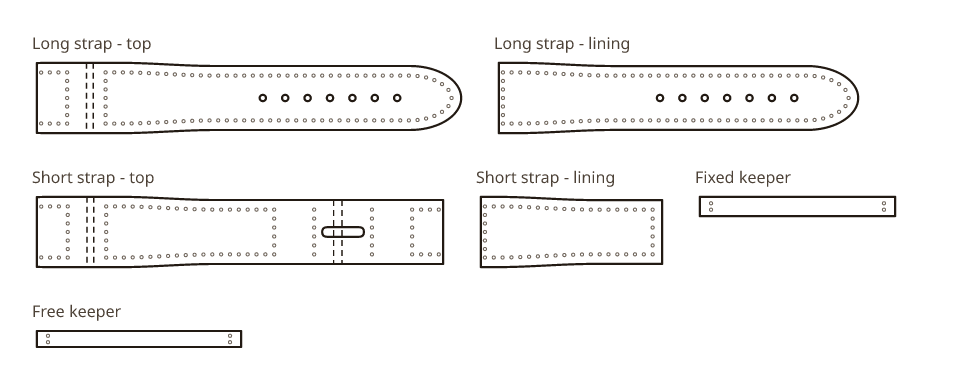
Patterns by lug width
| Lug width | Buckle | Long top cut | Short top cut | Keepers cut | Stitch holes |
|---|---|---|---|---|---|
| 18 mm strap | 16 mm | 132.5 mm (5 3/16 in) | 127.1 mm (5 in) | 52.9 mm and 55.9 mm | 315 |
| 20 mm strap | 18 mm | 132.6 mm (5 1/4 in) | 127.1 mm (5 in) | 56.9 mm and 59.9 mm | 321 |
| 22 mm strap | 20 mm | 132.6 mm (5 1/4 in) | 127.1 mm (5 in) | 60.9 mm and 63.9 mm | 332 |
| 24 mm strap | 22 mm | 132.6 mm (5 1/4 in) | 127.1 mm (5 in) | 64.9 mm and 67.9 mm | 342 |
Long and short tops include the folded ends. Keepers: fixed and free keeper, cut length. Stitch holes: every layer and both keepers.
Every lug width from 9 to 30 mm
Any whole lug width in this range can be made in the Studio. The table shows what the default settings give at each width, and which widths need one setting changed first.
| Lug width | Buckle | Keepers cut | Stitch holes | At the default settings |
|---|---|---|---|---|
| 9 mm | 8 mm | — | — | Change first: smaller adjustment holes or a stitch line nearer the edge |
| 10 mm | 8 mm | — | — | Change first: smaller adjustment holes or a stitch line nearer the edge |
| 11 mm | 9 mm | — | — | Change first: smaller adjustment holes or a stitch line nearer the edge |
| 12 mm | 10 mm | — | — | Change first: smaller adjustment holes or a stitch line nearer the edge |
| 13 mm | 11 mm | — | — | Change first: the stitch spacing or the tip shape (holes too close at the tip) |
| 14 mm | 12 mm | 44.9 mm and 47.9 mm | 297 | Ready |
| 15 mm | 13 mm | — | — | Change first: the stitch spacing or the tip shape (holes too close at the tip) |
| 16 mm | 14 mm | 48.9 mm and 51.9 mm | 308 | Ready |
| 17 mm | 15 mm | 50.9 mm and 53.9 mm | 308 | Ready |
| 18 mm | 16 mm | 52.9 mm and 55.9 mm | 315 | Ready |
| 19 mm | 17 mm | 54.9 mm and 57.9 mm | 321 | Ready |
| 20 mm | 18 mm | 56.9 mm and 59.9 mm | 321 | Ready |
| 21 mm | 19 mm | 58.9 mm and 61.9 mm | 326 | Ready |
| 22 mm | 20 mm | 60.9 mm and 63.9 mm | 332 | Ready |
| 23 mm | 21 mm | 62.9 mm and 65.9 mm | 332 | Ready |
| 24 mm | 22 mm | 64.9 mm and 67.9 mm | 342 | Ready |
| 25 mm | 23 mm | 66.9 mm and 69.9 mm | 345 | Ready |
| 26 mm | 24 mm | 68.9 mm and 71.9 mm | 345 | Ready |
| 27 mm | 25 mm | 70.9 mm and 73.9 mm | 356 | Ready |
| 28 mm | 26 mm | 72.9 mm and 75.9 mm | 358 | Ready |
| 29 mm | 27 mm | 74.9 mm and 77.9 mm | 366 | Ready |
| 30 mm | 28 mm | 76.9 mm and 79.9 mm | 369 | Ready |
6 narrow widths need one setting changed before they build; the Studio says which one.
Two versions
- Watch strap · Custom
- Every setting: lined or single layer, padding, hole shapes and stitching. The folds are computed from your leather thickness and bar sizes.
- Watch strap · Classic
- The traditional lined strap with only the essentials: width, size and tip.
Not yet confirmed in leather: this version follows our workshop drawing of a 22 mm strap in size M, and other widths, sizes and tips are computed from it. The folds are fixed as drawn: they do not change with your leather or your buckle and spring bars, so use leather of the thickness shown on each piece. Before you cut your good leather, mock up the folded ends in scrap leather of that thickness, around your real buckle and spring bar.
Lined or single layer
- Lined (two layers)
- Top leather and lining, stitched through matching holes. The default: 1.2 mm (3 oz) top leather on a 1.0 mm (2.5 oz) lining.
- Single layer
- One layer, no lining and no edge stitching. Only the folded ends are stitched.
Hardware you need
- Spring bars
- Two, to fit your watch's lug width. The pattern starts at 1.5 mm across; enter yours, measured with calipers.
- Buckle
- As wide as the strap's buckle end. The Studio computes the buckle end for a 2 mm buckle bar with a 1.8 mm tongue wire. Check yours with calipers; if your bar is thinner or thicker, the buckle fold changes (see the calculator).
- Leather
- Top leather 1.2 mm (3 oz) and lining 1.0 mm (2.5 oz) by default, or one layer for a single-layer strap.
Before you cut
The fold model behind these numbers is checked in software.
Make your strap
Start with your lug width. The pattern is drawn as you type, and the download has a printable PDF (US Letter or A4) and SVG and DXF files.
- Open Watch strap · CustomEvery setting: lined or single layer, padding, hole shapes and stitching.
- Open Watch strap · ClassicThe traditional lined strap with only the essentials: width, size and tip.
Questions
What lug widths can I make?
Any whole lug width from 9 to 30 mm. The buckle end can be as narrow as 8 mm and never wider than the lugs. Pages with the full cut list exist for 18 mm, 20 mm, 22 mm, 24 mm.
How much leather does the buckle fold take?
For the default 1.2 mm (3 oz) leather around a 2 mm buckle bar, 5.9 mm (1/4 in); around a 1.5 mm spring bar, 4.3 mm (3/16 in). The pattern adds it to the folded ends for you.
What leather thickness does the pattern use?
By default 1.2 mm (3 oz) top leather and a 1.0 mm (2.5 oz) lining. You can enter 0.6 mm to 2.5 mm for the top; the folds and holes are computed again for your thickness.
Can I cut it with a laser?
Yes, after a cleanup. The SVG and DXF are true-scale files of the pattern sheet: keep the piece outlines and the holes, and delete the labels, test squares and guide lines before cutting.
Guides
Numbers from Watch strap · Custom, pattern version 2.0.1 (engine 2.0.0), at the default settings. Updated October 27, 2026.