
Watch strap keeper size: how long and wide to cut the loops
For a 22 mm watch strap (20 mm at the buckle, 1.2 mm top leather on a 1 mm lining) the fixed keeper is 6 mm wide and cut 60.9 mm (2 3/8 in) long, the free keeper 5 mm wide and cut 63.9 mm (2 1/2 in). Those are the two loops the long piece runs through: a fixed one stitched just behind the buckle and a free one that slides. The length is not a guess: it is the distance around the two strap pieces the keeper wraps, plus the keeper's own thickness and a 7 mm lap where its ends are stitched. Below is where each term comes from and a table by lug width.
What a keeper wraps
A keeper is a flat strip bent into a loop around two things: the short strap it sits on, and the long strap that passes through it. Its inside must go around both. Flatten that loop and its length is twice the strap width, plus twice the thickness of what it wraps (the short strap under it and the long strap through it), plus a little room so the long strap slides, plus the length the keeper's own leather uses to turn the corners, plus the lap where the two ends overlap and are stitched.
- Strap width at the keepers
- 20 mm
- Wrapped thickness
- short strap 2.2 mm (top and lining) under the keeper; long strap 2.2 mm through it
- Keeper leather
- 1.0 mm (2.5 oz)
- Lap (stitched overlap)
- 7 mm
- Fixed keeper
- 6 mm wide, cut 60.9 mm (2 3/8 in)
- Free keeper
- 5 mm wide, cut 63.9 mm (2 1/2 in)
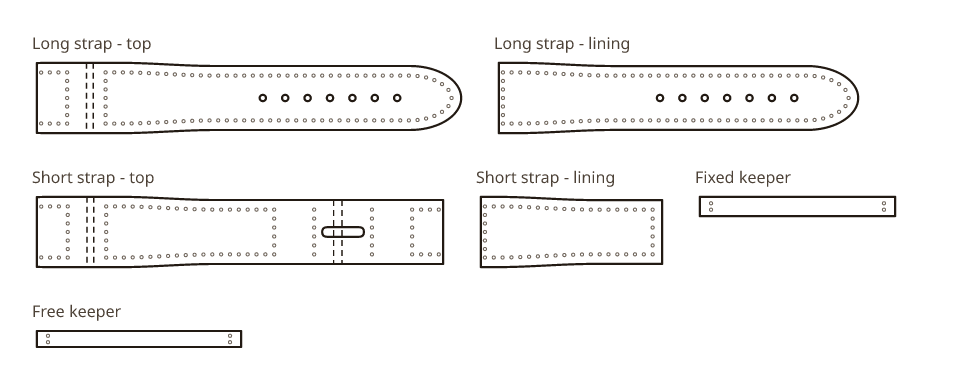
The free keeper is cut 3 mm longer than the fixed one because it has to slide: it gets more room inside. The fixed keeper is glued to a stitch-free seat on the short strap and holds the long strap close behind the buckle.
How wide
Keepers are narrow: 6 mm for the fixed one and 5 mm for the free one by default, anywhere from 4 mm to 7 mm. The fixed keeper is a little wider because it also hides the start of the stitching behind the buckle; the free keeper is slimmer so it slides and looks light. On a narrow strap of 16 or 18 mm, go toward 4 mm; on a 24 mm strap, 7 mm looks right.
Keeper lengths by lug width
The engine cuts these lengths at its default settings (1.2 mm top leather, 1 mm lining, 1 mm keeper leather, 2 mm taper from the lugs to the buckle). Thicker leather, a thicker keeper or no taper makes every length longer; the generator redraws them for your inputs.
| Lug width | Strap at the keeper | Fixed keeper (6 mm wide) | Free keeper (5 mm wide) |
|---|---|---|---|
| 14 mm | 12 mm | 44.9 mm (1 3/4 in) | 47.9 mm (1 7/8 in) |
| 16 mm | 14 mm | 48.9 mm (1 15/16 in) | 51.9 mm (2 1/16 in) |
| 18 mm | 16 mm | 52.9 mm (2 1/16 in) | 55.9 mm (2 3/16 in) |
| 20 mm | 18 mm | 56.9 mm (2 1/4 in) | 59.9 mm (2 3/8 in) |
| 22 mm | 20 mm | 60.9 mm (2 3/8 in) | 63.9 mm (2 1/2 in) |
| 24 mm | 22 mm | 64.9 mm (2 9/16 in) | 67.9 mm (2 11/16 in) |
| 26 mm | 24 mm | 68.9 mm (2 11/16 in) | 71.9 mm (2 13/16 in) |
Each 2 mm of strap width adds 4 mm to a keeper: the loop goes around the strap twice. Odd widths and the full cut lists are on the size pages.
Making and fitting the keepers
- Cut the strips to the printed length and width from 1.0 mm (2.5 oz) leather, or from the top leather skived down to that.
- Skive both ends thin over the lap length so the overlap is no thicker than the keeper itself.
- Finish the long edges first: bevel and burnish or paint them while the strip is flat.
- Wrap the fixed keeper around the short strap at its seat behind the buckle, lap the ends on the underside, glue and stitch through the lap holes (2 per end on the pattern).
- Wrap the free keeper around the short strap and the long strap together, with the long strap in place, so the loop takes its real size, then lap, glue and stitch it the same way. It must slide with a little friction.
The fixed keeper's seat is marked on the short strap: a band with no stitch holes, just behind the tongue slot, so the keeper lies flat and is not sewn over. Keep it there; a fixed keeper moved toward the lugs lets the long strap's tip flap behind the buckle.
Check before you cut
Wrap a strip of paper around both strap pieces where the keeper will sit, mark where it overlaps, add the lap, and compare with the printed length. If your leather is thicker than the pattern's 1.2 mm top and 1 mm lining, the paper will tell you before the leather does. A keeper that is too short will not close; one that is too long rattles.
Get the keepers drawn for your strap
Enter the lug width, buckle width, leather thickness and keeper leather, and both keeper strips are drawn to length with their lap and stitch holes, next to the straps.
- Open Watch strap · CustomEvery setting: lined or single layer, padding, hole shapes and stitching.
Questions
How long should a watch strap keeper be?
Long enough to wrap both strap pieces, plus its own thickness and a 7 mm lap: 60.9 mm for the fixed keeper and 63.9 mm for the free one on a 22 mm strap in 1.2 mm leather. Every 2 mm of strap width adds 4 mm.
How wide should a watch strap keeper be?
6 mm for the fixed keeper and 5 mm for the free one is the usual pair; anywhere from 4 mm to 7 mm looks right, narrower on narrow straps.
What is the difference between a fixed and a free keeper?
The fixed keeper is stitched to the short strap just behind the buckle and holds the long strap's tip close to the buckle. The free keeper slides along the short strap and is moved to wherever the tip ends at your wrist size. Both are cut from the same leather; the free one is a little longer so it can slide.
Why is the keeper on the pattern longer than the strap is wide, times two?
Because the loop also goes around the thickness of two strap pieces, needs room for the long strap to slide, uses leather to turn its four corners, and has an overlap where its ends are stitched. On the default strap those add 20.9 mm to twice the 20 mm strap width.
Related
Numbers from the watch strap engine (pattern version 2.0.1). Updated October 25, 2026. More guides.