
Leather wallet pattern: how a bifold is sized from the card
A bifold wallet pattern for a standard bank card (86 × 54 mm (3 3/8 × 2 1/8 in), the 85.6 mm card rounded up) is 3 pieces of leather, one outer shell and 2 card pockets, and every size follows from the card. For that card and 1.5 mm (4 oz) leather, each panel is 96 mm (3 3/4 in) wide, the spine between the two folds is 5 mm, and the shell is cut 197 × 92 mm (7 3/4 × 3 5/8 in). Here is where each number comes from, what the spine must allow for, and what to mock up before you cut.
The pieces of a bifold wallet
A plain bifold is the simplest wallet to pattern: a shell that folds once in the middle, and on each inside half a column of card pockets sewn along three edges. The cash goes behind the pockets, across the full width. The default pattern draws 2 pieces and cuts 3: the pocket is cut once for each side.
| Piece | Cut | Cut size (width × height) | Stitch holes |
|---|---|---|---|
| Outer shell | 1 | 197 × 92 mm (7 3/4 × 3 5/8 in) | 73 |
| Card pocket | 2 | 96 × 38.5 mm (3 3/4 × 1 1/2 in) | 35 |
Leather 1.5 mm (4 oz); stitch spacing 3.5 mm; the stitch line 3 mm inside the cut edge; corners rounded to 6 mm.
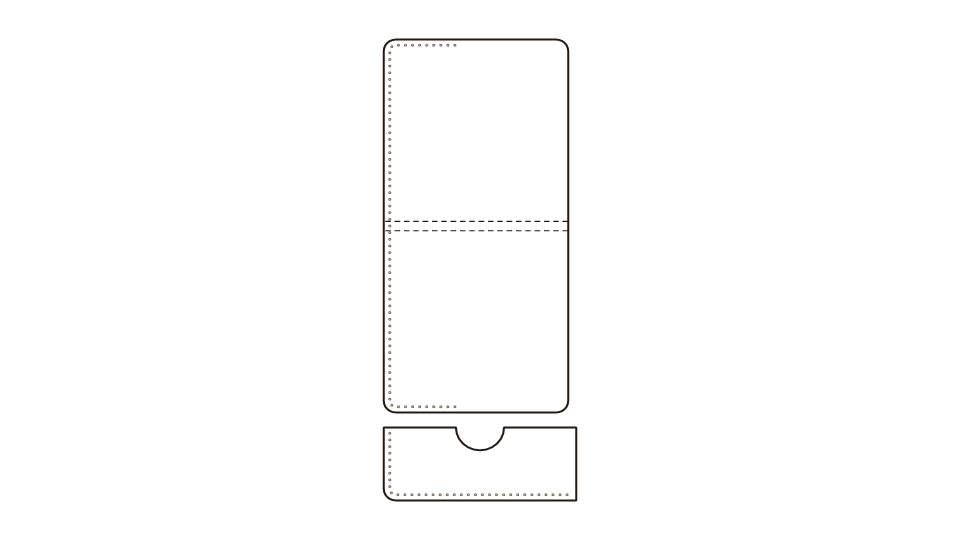
Where each size comes from
Panel width: the card plus a margin
Each half of the wallet must hold the card with leather around it. The panel width is the card width plus a margin on each side: 86 mm + 2 × 5 mm = 96 mm. The margin covers the stitch line (3 mm from the edge) and leaves the card room to slide.
Spine: the fold needs its own width
Between the two fold lines the shell wraps around the thickness of everything inside. The engine's spine is twice the leather thickness plus 2 mm of ease: 2 × 1.5 mm + 2 mm = 5 mm. In thicker leather the spine grows; in a wallet with more layers it must grow more (see the note below).
Shell: two panels and the spine
The shell is cut as one piece: 2 × 96 mm + 5 mm = 197 mm wide, and 92 mm tall, which is the wallet's height when folded. It is wider than a Letter or A4 page is wide, so on paper it prints across the page and on a tiled layout if needed.
Card pockets: part of the card shows
The front pocket is cut 38.5 mm tall: 62 % of the card height plus the bottom margin, so 20.5 mm of the card shows above it and can be gripped. With one pocket per side the pattern has one pocket piece per side; the generator allows up to 3 slots per side.
Stitching and holes
The pockets are sewn to the shell along their sides and bottom, through one set of holes, so the pocket and the shell carry the same hole positions. Stitch spacing is 3.5 mm by default with 1 mm holes, and the stitch line sits 3 mm inside the cut edge. The top edge of each pocket stays open and unsewn; a short backstitch at both ends of the pocket mouth takes the strain of cards going in and out.
Punch the holes before you glue if you use a laser or want to pre-punch every piece; or glue the pocket to the shell first and punch through both layers with a pricking iron along the printed line. Either way the shell's holes and the pocket's holes are the same holes.
Before you cut leather
The note above is printed on the generator page and in the PDF and SVG files. In plain terms: the spine formula counts the shell's own two thicknesses and the ease, not the pocket layers or the cards, so a loaded wallet may stand open. Mock up the shell and the pockets in scrap leather of your thickness, put your cards in, and widen the spine if it does not close. For a wallet with several slots per side, the extra is roughly one leather thickness per extra layer on each side.
- Print page 1 at 100 % and measure the 50 mm square before anything else.
- Cut the shell and one pocket in card stock, fold, and check that a card slides into the pocket.
- Cut the same in scrap leather of your working thickness, glue one pocket, fold the shell with cards inside, and check that it closes flat.
- Then cut the good leather, pockets first (they are the small pieces), shell last.
Other wallet patterns
If you want fewer pieces, a card holder is a wallet without the fold: a back panel with pockets, sewn around the outside. Our card holder generator draws 6 styles from the same card math (every layer 105 mm wide for the standard card), including a folded slim wallet made from one piece. Long wallets and zip wallets are not in the generator yet.
Make your bifold wallet pattern
Enter your card size, wallet height, leather thickness and the number of slots, and the shell and pockets are drawn for them. The download has a printable PDF (US Letter or A4) with the 50 mm square on every page, plus SVG and DXF files.
- Open the bifold wallet generatorWallet with one to three stacked card slots per panel.
- Open Card holder · CustomEvery setting: 1–3 pockets per side, 6 styles and 19 pocket edge shapes.
Questions
How wide should a bifold wallet pattern be?
For a standard 86 mm card and 1.5 mm leather, the shell is 197 mm wide: two panels of 96 mm and a 5 mm spine. Change the card, the margin or the leather thickness and the width changes with them.
How much spine does a bifold wallet need?
At least twice the shell's leather thickness plus some ease, which is 5 mm for 1.5 mm leather in the generator's current version. A wallet with card-slot layers and cards inside needs more; mock it up in scrap leather with your cards and widen the spine until it closes flat.
What leather thickness is best for a bifold wallet?
The generator's default shell is 1.5 mm (4 oz). Trade practice keeps wallet shells around 1.0 to 1.4 mm and card pockets up to 1.2 mm (3 oz), so the folded edge stays thin. The folded spine of thick leather is stiff and wants a wider spine.
Can I make the wallet pattern for a different card size?
Yes. Enter the card's width and height in the generator and the panels, shell and pockets are drawn again for it. The engine accepts cards from 80 mm to 92 mm wide in the card holder; the bifold takes your card size directly.
Related
Numbers from the bifold wallet engine (pattern version 1.2.1). Updated October 25, 2026. More guides.