
Leather stitching hole spacing: stitch spacing, distance from the edge and hole size
Watch straps are stitched fine, 2.7 mm apart and 3 mm from the edge; a bifold wallet 3.5 mm apart and 3 mm from the edge; our card holder with a bold 5 mm stitch, 4 mm from the edge. Hand stitching in leather is set by those three numbers: the spacing between holes, the distance from the cut edge to the stitch line, and the hole size. Below are the common pricking-iron spacings in millimeters and stitches per inch, the rule for the leather left between a hole and the edge, and how a pattern fits a row of holes to an edge so the last hole lands where it should.
Stitch spacing: mm and stitches per inch
Pricking irons and stitching chisels come in fixed spacings. Older European irons are numbered by teeth per French inch, which is why their spacings look odd in millimeters; newer irons are sold in round metric steps. The table converts both to stitches per inch (25.4 mm divided by the spacing).
| Spacing | Stitches per inch | Typical use |
|---|---|---|
| 2.07 mm | 12.3 | Fine dress straps, small luxury goods |
| 2.25 mm | 11.3 | Fine dress straps, small luxury goods |
| 2.45 mm | 10.4 | Fine dress straps, small luxury goods |
| 2.70 mm | 9.4 | Watch straps, small goods |
| 3 mm | 8.5 | Watch straps, small goods |
| 3.38 mm | 7.5 | Wallets, notebook covers |
| 3.85 mm | 6.6 | Wallets, notebook covers |
| 4 mm | 6.3 | Wallets, notebook covers |
| 5 mm | 5.1 | Card holders with a bold stitch, belts, bags |
Numbered irons from one maker's series; other makers' irons differ by a few hundredths of a millimeter. Measure your own iron over ten teeth and divide by nine.
Our patterns default to 2.7 mm on watch straps and 5 mm on card holders, and let you enter any spacing your iron has. Fine spacing on a narrow strap looks right and spreads the load over more holes; the wider spacing on a card holder is faster to sew and shows the thread as a design line.
Distance from the edge
The stitch line sits a set distance inside the cut edge, and the rule of thumb is about one thickness of the sewn layers. Watch straps use 3 mm by default (1.5 mm to 5 mm allowed); wallets and card holders 4 mm; belts and heavy straps 4 mm or more. Closer than that and the edge can tear out; much further and the edge lifts away from the stitching.
What matters most is the bridge: the leather left between the hole's edge and the cut edge. Keep it at least 0.8 mm, or six tenths of the leather's thickness if that is more. With a 0.9 mm hole at 4 mm from the edge the bridge is 3.55 mm; the pattern engine refuses a layout that leaves less, and keeps at least 1 mm between any two holes.
Fitting a row to an edge
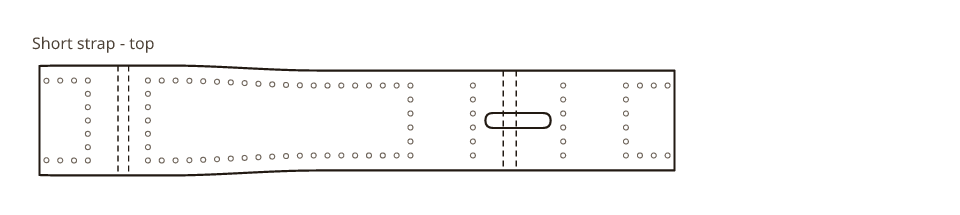
An edge is rarely a whole number of stitches long. A pattern has two honest choices. It can keep the iron's spacing exactly and let the row end short of the corner, or it can stretch the spacing slightly so a hole lands on every corner. Our engine does the second by default: on the long strap the 2.7 mm spacing becomes 2.71 mm, on the short strap 2.77 mm, and a hole sits exactly at each corner of the piece.
That stretch is invisible on one stitch and adds up over a row. Over the long strap's 83 edge holes a 2.7 mm iron drifts 0.4 mm from the printed holes by the end of one edge. If you punch with an iron rather than a laser, pick "match my iron exactly" in the generator: the spacing stays 2.7 mm and the free end of the row moves instead.
Two more rules a good pattern follows: a hole sits on every sharp corner, so the thread turns the corner cleanly, and no hole is ever removed from a visible row to make room for something hidden behind it; the hidden feature moves instead.
Hole size and shape
A pricking iron makes a slanted slit that closes around the thread; a punch or a laser makes a round hole that stays open. For round holes the finished size is about the thread's diameter divided by 0.7: a 0.6 mm thread wants a hole of about 0.85 to 1.0 mm. Our defaults are 1 mm on the strap and 0.9 mm on the card holder, which take 0.45 to 0.6 mm thread.
Thread follows the spacing. Around 2.5 to 2.8 mm, watch and wallet makers use 0.45 to 0.55 mm linen or polyester; at 3.0 to 3.4 mm, 0.55 to 0.65 mm; at 3.85 mm and above, 0.6 to 0.8 mm. A thread that fills the hole completely is hard to pull through two layers; one that rattles in it looks thin.
Counting the holes
A pattern that places its holes can also count them, which tells you the thread you need (about four times the seam length for a saddle stitch, plus the tails) and how long the sewing will take. The default 22 mm watch strap has 332 stitch holes across all its pieces; the default card holder has 114, of which 59 are on the back panel's seam.
- Watch strap
- 2.7 mm spacing, 3 mm from the edge, 1 mm holes; 332 holes at 22 mm
- Card holder
- 5 mm spacing, 4 mm from the edge, 0.9 mm holes
- Bifold wallet
- 3.5 mm spacing, 3 mm from the edge, 1 mm holes
- Between two rows
- 16 mm (5/8 in) on a 22 mm strap
Set your own stitch spacing
Enter your iron's spacing and the distance from the edge, and every hole on every layer is placed for them, with a hole on each corner or your iron's exact spacing, as you choose.
- Open Watch strap · CustomEvery setting: lined or single layer, padding, hole shapes and stitching.
- Open Card holder · CustomEvery setting: 1–3 pockets per side, 6 styles and 19 pocket edge shapes.
Questions
What stitch spacing should I use for leather?
Watch straps and fine small goods: 2.4 to 3.0 mm (our strap default 2.7 mm). Wallets and notebook covers: 3.0 to 4.0 mm (our bifold default 3.5 mm). Card holders with a bold stitch, belts and bags: 4 to 5 mm (our card holder default 5 mm). Pick the iron first; the pattern then spaces its holes to that iron.
How far from the edge should leather stitching be?
About one thickness of the sewn layers: 3 mm on a watch strap, 4 mm on a wallet or card holder, 4 mm and more on belts. Always leave at least 0.8 mm of leather between the hole and the cut edge.
How many stitches per inch is 3 mm spacing?
8.5 stitches per inch: 25.4 divided by 3.0. A 2.7 mm iron gives 9.4 stitches per inch and a 5 mm iron 5.1.
What size should laser-cut stitch holes be?
About the thread diameter divided by 0.7, so 0.85 to 1.0 mm for 0.6 mm thread. A laser cuts a hole a little larger than drawn (by about its beam width), and holes under about 1.2 mm may need an awl to open fully.
Why do my pre-punched holes drift from the pattern along a long edge?
Because the pattern stretched the spacing to land a hole on each corner and your iron did not. Over 41.5 holes a 2.7 mm iron drifts 0.4 mm from a 2.71 mm row. Choose the exact-iron spacing in the generator, or punch through the printed holes instead of walking the iron.
Related
Numbers from the watch strap engine (pattern version 2.0.1) and the card holder engine (pattern version 5.0.1). Updated October 25, 2026. More guides.