
Leather thickness: oz to mm chart, and which thickness each pattern uses
One ounce of leather weight is one sixty-fourth of an inch of thickness, 0.3969 mm. So 2 oz leather is about 0.79 mm, 3 oz about 1.19 mm and 5 oz about 1.98 mm. Leather is sold in one-ounce bands (2–3 oz, 4–5 oz), so a label can be off by ± 0.2 mm; measure with calipers before you cut. The chart below converts both ways, and the second half says which thickness each of our patterns is drawn for and why it matters for anything that folds.
Ounces to millimeters
The ounce in "4 oz leather" is not a weight you can put on a scale; it is a thickness. The trade defined one ounce as one sixty-fourth of an inch, which is 0.396875 mm. Multiply the ounces by that to get millimeters, or divide millimeters by it to get ounces.
| Weight | Thickness | Inches | Sold as |
|---|---|---|---|
| 1 oz | 0.40 mm | 1/64 in | 1–2 oz (0.4–0.8 mm) |
| 2 oz | 0.79 mm | 2/64 in | 2–3 oz (0.8–1.2 mm) |
| 3 oz | 1.19 mm | 3/64 in | 3–4 oz (1.2–1.6 mm) |
| 4 oz | 1.59 mm | 4/64 in | 4–5 oz (1.6–2.0 mm) |
| 5 oz | 1.98 mm | 5/64 in | 5–6 oz (2.0–2.4 mm) |
| 6 oz | 2.38 mm | 6/64 in | 6–7 oz (2.4–2.8 mm) |
| 7 oz | 2.78 mm | 7/64 in | 7–8 oz (2.8–3.2 mm) |
| 8 oz | 3.17 mm | 8/64 in | 8–9 oz (3.2–3.6 mm) |
| 9 oz | 3.57 mm | 9/64 in | 9–10 oz (3.6–4.0 mm) |
| 10 oz | 3.97 mm | 10/64 in | 10–11 oz (4.0–4.4 mm) |
| 12 oz | 4.76 mm | 12/64 in | 10–12 oz |
Shops sell leather in one-ounce bands and quote the band, so 2–3 oz leather is anywhere from 0.8 to 1.2 mm.
Going the other way: 1.0 mm is 2.5 oz, 1.2 mm is 3 oz, 1.5 mm is just under 4 oz, 2.0 mm is 5 oz, 3.0 mm is 7.5 oz and 4.0 mm is 10 oz. Our pages show both, millimeters first and ounces rounded to the half ounce in brackets, because the engine works in millimeters and most tools and hardware are metric.
Measure, do not trust the label
A hide is not one thickness. It is split to a band, and the band is 0.4 mm wide; the belly and the shoulder differ; and a vegetable-tanned hide may be a tenth thicker after it takes up moisture. For a flat piece the difference does not matter much. For a fold it does: 0.2 mm more leather around the same bar lengthens the fold and moves the hidden holes with it.
- Use a dial or digital caliper, not a ruler on the edge. Measure where the piece will be cut, not at the corner of the hide.
- Measure three places along the piece and use the largest value for a fold and the smallest for a pocket.
- After skiving a fold end, measure the skived part again; that is the thickness the fold sees.
- Enter the measured value in millimeters in the generator, with one decimal.
What our patterns are drawn for
Each generator takes the leather thickness as an input and redraws the pieces for it. These are the defaults and the ranges.
| Piece | Default | Accepted | What the thickness changes |
|---|---|---|---|
| Watch strap top | 1.2 mm (3 oz) | 0.6 mm–2.5 mm | The fold at the buckle bar and at the spring bars, and the skived turnbacks |
| Watch strap lining | 1.0 mm (2.5 oz) | 0.4 mm–1.6 mm | The strap's total thickness and whether it passes the buckle frame |
| Watch strap keeper | 1.0 mm (2.5 oz) | 0.6 mm–1.5 mm | The keeper blank's length (it wraps its own thickness too) |
| Card holder (folded styles) | 1.4 mm (3.5 oz) | 0.8 mm–2.0 mm | The length of the folded piece; flat styles do not change |
| Bifold wallet shell | 1.5 mm (4 oz) | — | The spine between the folds: 2 × thickness + 2 mm = 5 mm |
Change the thickness in the generator and the folded pieces are drawn again; the flat pieces keep their size.
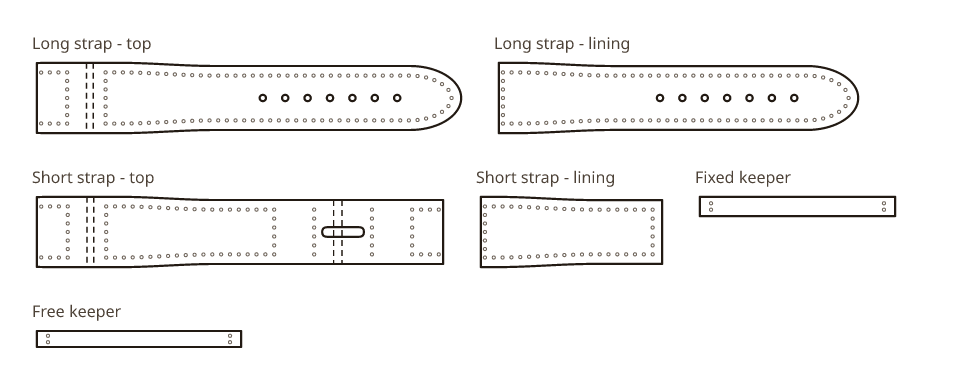
Why thickness matters most at a fold: the leather that wraps a bar is taken from the length, and more leather around the same bar takes more. The default strap's 1.2 mm top, thinned to 1 mm at the fold, uses 5.9 mm around a 2 mm buckle bar. Enter a thicker top and that number grows; the fold guide has the calculator.
Typical thickness by product
These are the ranges makers and suppliers quote, as a starting point, not a rule. Our generators accept values outside them where the construction allows.
| Product | Thickness | About |
|---|---|---|
| Watch strap, top leather | 1.0–1.4 mm | 2.5–3.5 oz |
| Watch strap, lining | 0.6–1.0 mm | 1.5–2.5 oz |
| Card holder pockets | 0.8–1.2 mm | 2–3 oz |
| Wallet shell | 1.0–1.4 mm | 2.5–3.5 oz |
| Wallet interior | 0.6–0.9 mm | 1.5–2 oz |
| Notebook cover | 1.4–2.0 mm | 3.5–5 oz |
| Belt | 3.5–4.5 mm | 9–11 oz |
| Dog collar | 3–4 mm | 7.5–10 oz |
Draw the pattern for your leather
Measure your leather with calipers, enter the thickness, and the folds, turnbacks and spine are drawn for it. Thickness is shown in millimeters with ounces next to it.
- Open Watch strap · CustomEvery setting: lined or single layer, padding, hole shapes and stitching.
- Open Card holder · CustomEvery setting: 1–3 pockets per side, 6 styles and 19 pocket edge shapes.
Questions
How thick is 1 oz leather in mm?
0.40 mm, one sixty-fourth of an inch. 2 oz is 0.79 mm, 3 oz is 1.19 mm, 4 oz is 1.59 mm, 5 oz is 1.98 mm, 8 oz is 3.17 mm.
How many oz is 1.2 mm leather?
3 oz. Divide millimeters by 0.3969: 1.0 mm is 2.5 oz, 1.5 mm is just under 4 oz, 2.0 mm is 5 oz, 3.0 mm is 7.5 oz.
What thickness leather is best for a watch strap?
About 1.2 mm for the top and 1 mm for the lining, which is what our strap is drawn for by default; the finished strap is then about 2.2 mm. Fine dress straps go thinner, rugged straps up to 1.6 mm tops. The folds are redrawn for the thickness you enter.
What thickness leather for a card holder or wallet?
Pockets 0.8 to 1.2 mm (2–3 oz) so the sewn edge stays thin; shells 1.0 to 1.4 mm. Our card holder's folded styles default to 1.4 mm and the bifold shell to 1.5 mm.
Why does leather thickness change a pattern?
Only where the leather folds. Around a bar or on itself, thicker leather uses more length, so the flat piece must be longer: the default strap uses 5.9 mm at its 2 mm buckle bar for 1.2 mm leather, and a bifold's spine is twice the leather thickness plus 2 mm.
Related
Numbers from the watch strap engine (pattern version 2.0.1), the card holder engine (pattern version 5.0.1) and the bifold wallet engine (pattern version 1.2.1). Updated October 25, 2026. More guides.