
How to make a leather watch strap: the pattern, piece by piece
A two-piece leather watch strap is sized from one number you can measure, the gap between the watch's lugs: 22 mm on the default pattern. For a 22 mm lug and a 20 mm buckle, the long strap finishes at 115 mm (4 1/2 in) and is cut 132.6 mm (5 1/4 in); the short strap finishes at 75 mm (2 15/16 in) and is cut 127.1 mm (5 in). The difference is the leather that wraps the spring bar and the buckle bar: 4.3 mm and 5.9 mm for 1.2 mm leather. This guide walks through the 6 pieces, the folds, the stitching and the build order.
Measure the watch first
Measure the gap between the lugs with calipers, in millimeters. Most watches are 18, 20, 22, 24 mm; the generator accepts 9 to 30 mm. Then measure the inside width of your buckle: a strap usually tapers 2 mm from the lugs to the buckle, so a 22 mm strap takes a 20 mm buckle, and the strap must pass through it.
Measure the hardware too, because the folds depend on it: the buckle bar (2 mm on the default), the spring bars (1.5 mm) and the buckle's tongue wire (1.8 mm). Then measure your leather with calipers at the place you will cut, not from the label; leather is sold in bands about 0.4 mm wide, so the label can be off by 0.2 mm.
The 6 pieces
| Piece | Cut length × width | Leather | Stitch holes |
|---|---|---|---|
| Long strap - top | 132.6 mm × 22 mm | 1.2 mm (3 oz) | 101 |
| Long strap - lining | 112.4 mm × 22 mm | 1.0 mm (2.5 oz) | 88 |
| Short strap - top | 127.1 mm × 22 mm | 1.2 mm (3 oz) | 86 |
| Short strap - lining | 56.8 mm × 22 mm | 1.0 mm (2.5 oz) | 49 |
| Fixed keeper | 60.9 mm × 6 mm | 1.0 mm (2.5 oz) | 4 |
| Free keeper | 63.9 mm × 5 mm | 1.0 mm (2.5 oz) | 4 |
Finished long strap 115 mm (spring bar to tip), short strap 75 mm (spring bar to buckle bar). 332 stitch holes in all.
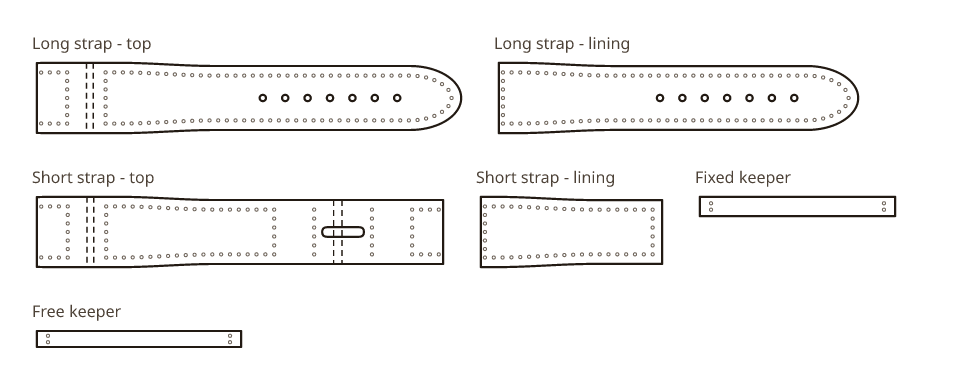
Lengths are measured the way strap makers quote them: the long strap from the spring bar's center to the tip, the short strap from the spring bar's center to the buckle bar's center, buckle not included. The flat pieces are longer than that at both ends, because each end folds around a bar and is glued back on itself.
The linings are shorter than the tops. The long lining (112.4 mm) stops before the spring bar fold, and the short lining (56.8 mm) stops where the folded buckle end comes back, so the strap is two layers thick everywhere and the folds carry only the top leather.
The two folds
Every end of a strap wraps a bar, and the leather that goes around the bar is taken from the length. For 1.2 mm top leather thinned to 1 mm at the fold, the engine adds 5.9 mm (1/4 in) at a 2 mm buckle bar and 4.3 mm (3/16 in) at a 1.5 mm spring bar, each with a little play so the bar turns. Thicker leather or a fatter bar uses more; the fold guide has a calculator.
At the buckle end the top leather also needs a slot for the buckle's tongue: 13.1 mm long and 3 mm wide on the default, placed so the tongue can swing through while the bar sits in its fold. The turnback behind the buckle is 34.3 mm of flat leather past the bar's center, skived thin so the layers stay slim.
The stitch holes on both sides of each fold are placed on the folded strap and unfolded onto the flat pattern, so when you fold the end back the hidden row meets the visible row. A pattern that mirrors the holes across the fold line as if leather had no thickness misses by the fold's extra length.
Stitching and keepers
Watch straps are stitched fine: 2.7 mm spacing with 3 mm from the edge by default, and 16 mm between the two rows on a 22 mm strap. The engine fits the spacing to each edge so a row ends on a whole hole: 2.71 mm on the long strap and 2.77 mm on the short one here. If you use a pricking iron, pick its exact spacing in the generator instead, so the iron's teeth land in the printed holes.
The two keepers are strips of 6 mm and 5 mm width, cut 60.9 mm and 63.9 mm long for this strap: enough to wrap the short strap and the long strap passing over it, plus 7 mm where the ends overlap and are stitched. The fixed keeper sits just behind the buckle on a stitch-free seat; the free keeper slides.
Order of work
- Print page 1 at 100 % and measure the 50 mm square. Cut the pattern in paper and check the lengths on your wrist.
- Cut the tops, the linings and the keeper strips from the leather thickness printed on each piece. Cut the long strap top first.
- Skive the fold ends thin as the sheet marks them, and punch the tongue slot and the adjustment holes.
- Fold each end around its real bar and glue the turnback. Check that the holes on both sides of the fold meet; if they do not, stop and read the fold note on the sheet.
- Glue the linings on, pin through the marked holes, and trim the edges together after the glue has set.
- Punch the stitch holes through both layers along the printed line (or pre-punch each layer before gluing), then saddle stitch, keepers last.
- Bevel, burnish or paint the edges, and fit the buckle with its bar.
Make your watch strap pattern
Enter the lug width, the buckle width and your leather and bar sizes; the straps, linings and keepers are drawn for them, folds included. The download has a printable PDF (US Letter or A4) with the 50 mm square on every page, plus SVG and DXF files.
- Open Watch strap · CustomEvery setting: lined or single layer, padding, hole shapes and stitching.
- Open Watch strap · ClassicThe traditional lined strap with only the essentials: width, size and tip.
Questions
How long should a leather watch strap be?
The default is 115 mm for the long strap and 75 mm for the short one, measured from the spring bar; together with the watch that fits an average wrist. The generator offers size presets from XS to XL and accepts 90 to 160 mm long and 55 to 105 mm short.
What buckle fits a 20 mm watch strap?
Usually an 18 mm buckle: straps taper about 2 mm from the lugs to the buckle. The buckle's inside width must be at least the strap's buckle-end width, and the generator checks that the folded strap passes through the buckle frame.
What leather thickness should a watch strap be?
1.2 mm (3 oz) top leather with a 1 mm lining is the default and gives a strap about 2.2 mm thick. The generator accepts 0.6 mm to 2.5 mm tops and 0.4 mm to 1.6 mm linings and redraws the folds for them.
How many stitch holes does a watch strap have?
332 on the default 22 mm strap at 2.7 mm spacing, all layers together: 83 along the long strap's edges, 42 along the short strap's, the rest in the rows across the folds and in the keepers.
Why are the strap pieces longer than the finished length?
Each end folds around a bar and is glued back on itself. For 1.2 mm leather the fold takes 4.3 mm at the 1.5 mm spring bar and 5.9 mm at the 2 mm buckle bar, and the turnback behind each bar adds the glued length.
Related
Numbers from the watch strap engine (pattern version 2.0.1). Updated October 25, 2026. More guides.