
Leather pattern PDF: 8 things to check before you print and cut
Before you cut leather from any pattern PDF, run 8 checks: that it names its paper size (US Letter or A4), carries a 50 mm test square, states the leather thickness it was drawn for, shows the stitch holes on every layer and gives every fold its extra length. A pattern PDF is only as good as what it tells you. Free patterns and paid ones fail these checks alike; here is the list, with the numbers our own engine prints so you know what to look for.
Why a PDF pattern needs checking
Paper is forgiving; leather is not. A pattern that is 4 % too small still looks right on the desk, but a card will not go into its pocket. A pattern drawn for 1.0 mm leather folds wrong in 2.0 mm leather. A pattern with holes on one layer only leaves you punching the second layer by eye. The checks below take ten minutes and cost nothing; cutting the wrong pattern costs a piece of leather.
This applies to free downloads, to paid patterns from shops and to the patterns this site computes. Our generator shows every pattern as a free preview with its numbers; each file you download (PDF, SVG or DXF) costs one credit, and the pricing page says so plainly.
The 8 checks
1. The paper size is named
A PDF is made for one paper size. US Letter is 215.9 × 279.4 mm, A4 is 210 × 297 mm. Printing an A4 file on Letter paper, or the other way round, makes the printer shrink the page or cut off an edge. The file name, the first page or the download screen should say which paper it is for. Our PDFs are made at the paper you pick, and every page is that exact size.
2. There is a test square, and you measure it
Every page of a good pattern carries a size check: a 50 mm square, an inch square or a 100 mm ruler. Print page 1, lay a steel ruler on the square and measure outer edge to outer edge on both sides. 49.8 to 50.2 mm is a true print. About 47 or 48 mm means the print window was set to Fit to page. A pattern with no size check can still be right, but you cannot tell.
3. The leather thickness is stated
Any piece that folds was drawn for one thickness. The default watch strap is drawn for 1.2 mm top leather and 1 mm lining; the card holder's folded styles start at 1.4 mm and accept 0.8 mm to 2 mm. If the PDF does not say what thickness it expects, assume its folds are drawn as zero-thickness lines and mock them up in scrap leather first.
4. Stitch holes are on every layer, in the same places
Two layers sewn together need one set of holes. A pattern that shows the holes on the top piece only, or spaces them separately on the lining, leaves the two rows to drift apart. Look for the same hole count on both pieces of a pair. On the default strap the long strap top and its lining share the same edge rows; the top has 101 holes and the lining 88, the difference being the holes that sit on the folded turnback, which the lining does not reach.
5. Folds have their extra length
Leather wrapping a bar travels around it, so the flat piece must be longer than the finished one. On the default strap that is 5.9 mm (1/4 in) at the 2 mm buckle bar and 4.3 mm (3/16 in) at each 1.5 mm spring bar. A PDF whose fold is a single dashed line, with the holes mirrored across it, was drawn as if leather had no thickness. The folded holes will miss by a few millimeters.
6. Pockets are wider than what goes in them
A card pocket cut to the card's width will not take the card once it is sewn. The default card holder cuts every layer 105 mm (4 1/8 in) wide for an 85.6 mm card: 4 mm for the stitch line and 5.7 mm of clear space on each side. Check that the pattern's pocket width minus twice its stitch distance is wider than the card.
7. Every piece is labeled with its quantity and its leather
Each piece should say what it is, how many to cut and from which leather: top, lining, keeper. A strap pattern with two unlabeled rectangles leaves you guessing which is the lining. Our sheets print the piece name and its leather thickness on every piece and list them in a cut list.
8. The pattern says what has been built
A drawing is not a finished item. Ask whether the pattern has been cut and sewn in leather, and in what thickness. Our generator pages carry a status note for each pattern that says what has been built in leather and what has only been checked in software, and asks you to mock up the folds in scrap leather first. Treat a pattern without such a note as untested.
About free leather patterns
Free pattern PDFs are a good way to learn a construction, and many are well drawn. Run them through the same eight checks; the ones that fail most often are the test square (none), the thickness (not stated) and the fold length (a plain line). If a free pattern passes, print it at 100 %, cut it in paper, fold it, and only then cut leather.
What a free PDF cannot do is change with your measurements. If your card is not a standard bank card, your watch is not 20 mm between the lugs, or your leather is thicker than the author's, every number on the page is slightly wrong. That is the case for a pattern that is computed from your inputs instead of drawn once.
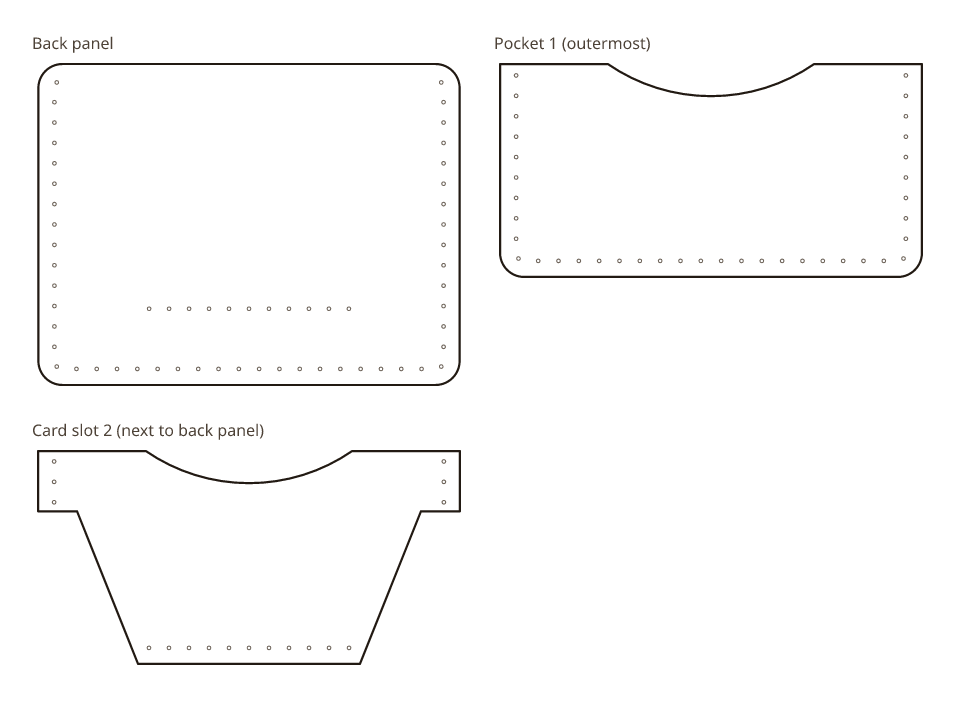
What our PDFs contain
- Page 1, Start here: a 50 mm square and a 2 in square, both marked CALIBRATION, and the cut list.
- Every pattern page: the 50 mm square again and a 100 mm ruler along the bottom, with the line "Print at 100 % scale".
- Each piece with its name, quantity and leather thickness; stitch holes on every layer; fold lines and bar marks with the fold's extra length already in the cut.
- A status note on the generator page and in the file: what has been built in leather, what to mock up first.
- SVG and DXF files of the same sheet for a laser or cutting machine, after a cleanup described on the home page.
We do not promise a fit. A pattern is computed from your numbers and checked in software; the leather check is yours, and the status note on each generator page says how far each pattern has been taken.
See a pattern computed for your sizes
Open a generator, enter your card or your watch's lug width, and read the pattern's numbers in the free preview. The download is a PDF at your paper size with the 50 mm square on every page, plus SVG and DXF.
- See every patternCard holders, watch straps and a bifold wallet, each computed from your measurements.
- See pricingWhat a download costs, in credits.
Questions
Are the patterns on Leather Pattern House free?
The preview is free: you see the pattern and its numbers as you change the settings. Each file you download (PDF, SVG or DXF) costs one credit; the pricing page lists the credit packs and plans. No card is needed to use the preview.
How do I know a free leather pattern PDF is true to scale?
Print its first page at 100 % and measure its test square with a steel ruler. If the PDF has no test square, measure a piece whose size is written on it. Without either you cannot know, so cut it in paper and check the paper pieces against the real object first.
Can I use a Letter-size pattern PDF in a country with A4 paper?
Yes, if you print it at 100 % and not Fit to page: the drawing is the same size on both papers, but a Letter page is 17 mm wider and 18 mm shorter than A4, so a piece near the edge may be cut off. Our download lets you pick the paper so the pages are laid out for it.
What leather thickness is a pattern drawn for if it does not say?
You cannot tell, so treat every fold as untested. Mock the folds up in scrap leather of the thickness you plan to use, around the real hardware, and move the hidden holes if they miss. Our patterns state their thickness on each piece (1.2 mm top and 1 mm lining on the default strap).
Related
Numbers from the card holder engine (pattern version 5.0.1) and the watch strap engine (pattern version 2.0.1). Updated October 25, 2026. More guides.